


Disclosure: We are reader-supported. If you buy through links on our site, we may earn a commission. Learn more.
Artificial intelligence has become one of the most powerful forces driving the U.S. stock market.
Technology companies are spending hundreds of billions of dollars building data centers, buying advanced chips and developing increasingly powerful AI models. Corporate profits remain strong. Some of America's largest companies are reporting rapid growth directly tied to artificial intelligence.
Stock prices have responded accordingly.
But as money continues pouring into AI and valuations climb, a more uncomfortable question is beginning to surface:
Is the AI boom becoming a stock-market bubble?
The answer is more complicated than it may first appear.
There is little doubt that artificial intelligence is a transformative technology. The companies leading the boom are also considerably stronger financially than many of the speculative internet companies that dominated the dot-com bubble.
At the same time, history shows that revolutionary technologies can produce very real economic change while still creating enormous financial bubbles along the way.
That may be the risk facing the market today.

Find Your Advisor Match
Personalized Advice for Portfolio Size $100k and Above

Answer a few questions and get matched with financial advisors based on your specific needs.

AI Has Become One of the Market's Biggest Growth Engines
The scale of the AI boom is difficult to overstate.
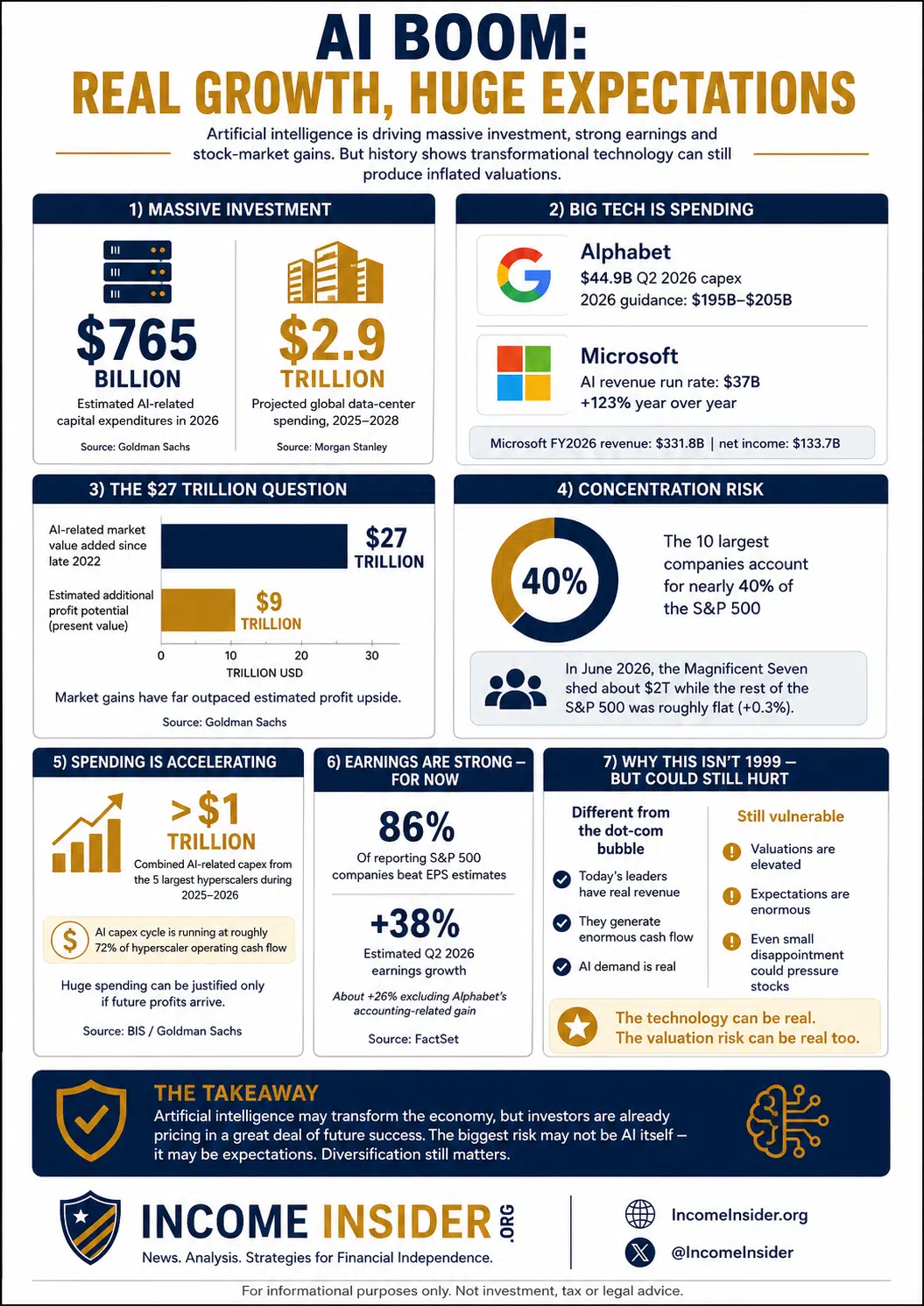
Goldman Sachs estimates that annual AI-related capital expenditures could reach roughly $765 billion in 2026, eventually climbing to approximately $1.6 trillion annually by 2031 under its baseline assumptions.
Morgan Stanley estimates that roughly $2.9 trillion could be spent globally on data centers between 2025 and 2028.
Some of the world's largest corporations are leading the charge.
Alphabet spent $44.9 billion on capital expenditures during the second quarter of 2026 alone, with the vast majority directed toward technical infrastructure supporting AI. The company has raised its full-year 2026 capital expenditure guidance twice this year, most recently to a range of $195 billion to $205 billion, up from an original outlook of roughly $175 billion to $185 billion.
Microsoft reported that its AI business surpassed a $37 billion annual revenue run rate, growing 123% year over year during its fiscal third quarter. For the full fiscal year, Microsoft generated $331.8 billion in revenue and $133.7 billion in net income.
These are not tiny companies selling dreams without revenue.
They are some of the most profitable businesses ever created.
That is one of the biggest differences between today's AI boom and the dot-com bubble of the late 1990s.
Why This Isn't Exactly Like the Dot-Com Bubble
Comparisons between AI and the dot-com era are inevitable.
During the late 1990s, investors correctly recognized that the internet would transform the global economy.
What many got wrong was how much individual internet companies were worth.
Money flooded into technology stocks. Companies with little revenue and sometimes no realistic path to profitability commanded enormous valuations simply because they were associated with the internet.
The Nasdaq Composite eventually peaked in March 2000 and subsequently lost roughly three-quarters of its value before reaching its bottom in 2002.
Yet the internet didn't disappear.
It changed the world.
Amazon survived. Google emerged. Online commerce exploded. Smartphones eventually placed the internet in billions of pockets.
The technology was real.
The valuations were the bubble.
That distinction is worth remembering today.
Goldman Sachs notes several major differences between the current environment and the dot-com era. Corporate profits have risen to record levels, corporate balance sheets remain relatively healthy and the companies leading today's technology boom generate enormous amounts of cash.
The International Monetary Fund has reached a similar conclusion using a different measure. In its January 2026 World Economic Outlook Update, the IMF estimated that potential overvaluation in the broad U.S. equity index is only about half as large as it was during the dot-com episode, even though valuations remain elevated by historical standards.
So anyone waiting for an exact repeat of 1999 may be looking for the wrong warning signs.
But that doesn't mean valuations no longer matter.
Related: Patrick Traverse - Why Entrepreneurs Need Systems for Taxes, Cash Flow, and Investing
The $27 Trillion Question
One of the more striking estimates comes from Goldman Sachs.
According to the firm's research, AI-related companies have added approximately $27 trillion in market value since late 2022.
Goldman separately estimated the present value of potential additional U.S. corporate profits generated by AI productivity gains at roughly $9 trillion under its baseline assumptions.
Those two numbers are not directly interchangeable, and they do not prove that AI stocks are three times too expensive.
But they illustrate the extraordinary expectations already embedded in the market.
For today's valuations to make sense, AI may need to produce enormous productivity improvements, revenue growth and profit expansion across the economy.
That certainly could happen.
The danger is what happens if it takes longer than expected.
Markets don't require AI to fail for AI stocks to fall.
They merely require reality to fall short of expectations.
Find Your Advisor Match
Personalized Advice for Portfolio Size $100k and Above
Answer a few questions and get matched with financial advisors based on your specific needs.
Companies Are Spending Enormous Amounts Before the Returns Are Fully Known
This may be the most important question surrounding the AI boom.
How much money will ultimately be earned from all of this infrastructure?
The Bank for International Settlements estimates that the five largest hyperscalers are on pace to spend more than $1 trillion on AI-related capital expenditures during 2025 and 2026 combined.
The BIS also notes that these commitments are increasingly outpacing earnings and free cash flow, pushing some companies toward additional borrowing.
Goldman Sachs has put that spending pace in historical context: the current AI capex cycle is running at roughly 72% of hyperscaler operating cash flow, still short of the more than 100% of operating cash flow that technology, media and telecom companies were spending during the peak of the late-1990s telecom boom, but closing the gap quickly.
Separately, Goldman has warned that hyperscalers may need to direct nearly all of their operating cash flow into AI buildouts in 2026, squeezing out room for stock buybacks.
This doesn't automatically mean the money is being wasted.
Demand for computing capacity remains enormous, and companies such as Microsoft and Alphabet are already reporting substantial AI-related revenue.
But the spending creates a very high hurdle.
Hundreds of billions of dollars invested in GPUs, servers, data centers, networking equipment and electricity infrastructure must eventually generate enough revenue to justify both the expenditures and the stock valuations built around them.
If that happens, today's AI boom could prove remarkably durable.
If it doesn't, the market may have a problem.
AI boom or bubble?
Even the Federal Reserve Is Watching AI Valuations
Concerns about AI have moved beyond bearish Wall Street commentators.
The Federal Reserve's May 2026 Financial Stability Report noted that equity valuations remained high and reported that market participants had raised several AI-related risks.
Those concerns included elevated stock valuations, increasing debt used to finance AI capital expenditures and the possibility that broader adoption of AI could weaken portions of the labor market.
A July Federal Reserve analysis also highlighted an unusual disconnect.
Financial markets have responded dramatically to developments in AI, while evidence of broad transformation across overall economic output and employment remains considerably more limited so far.
That gap doesn't mean AI won't eventually deliver.
It means financial markets may be pricing in some of tomorrow's productivity gains today.
The Stock Market Has Become Highly Concentrated
Another concern has little to do with whether artificial intelligence succeeds.
It has to do with diversification.
By mid-2025, the 10 largest companies in the S&P 500 represented nearly 40% of the index's total market capitalization, according to S&P Global, reaching a level of concentration not seen since the mid-1960s.
Many of those companies are either directly developing AI or are expected to benefit substantially from it.
That means Americans who believe they own a broadly diversified S&P 500 index fund may actually have considerably more exposure to a handful of enormous technology companies than they realize.
When those companies rise, the concentration works beautifully.
When they fall, the same mathematics works in reverse. June 2026 offered a clear example.
The "Magnificent Seven" (Apple, Microsoft, Amazon, Alphabet, Meta, Nvidia and Tesla) fell a median 9.7% that month and shed roughly $2 trillion in combined market value, with Microsoft alone down 17%, its worst month since December 2000.
Over the same stretch, the median stock in the rest of the S&P 500 was essentially flat, posting a median gain of just 0.3%. The index-level decline was, in other words, almost entirely a story about a handful of enormous companies.
Concentration doesn't cause a market crash.
It can, however, magnify one.
Strong Earnings Are Keeping the Bull Case Alive
There is also a major problem with declaring the AI boom a bubble today:
Companies are actually delivering.
S&P 500 earnings have been remarkably strong.
As of August 7, FactSet reported that both the percentage of companies beating earnings expectations and the size of those earnings surprises were running above historical averages — 86% of reporting companies beat EPS estimates, versus a five-year average of 78%.
Earlier in the reporting season, FactSet estimated Q2 S&P 500 earnings growth at nearly 38%. Even excluding Alphabet's unusually large accounting-related gain, earnings growth remained approximately 26%.
Analysts are also projecting unusually strong earnings growth through the remainder of 2026.
That matters because bubbles normally become most vulnerable when prices continue rising while the underlying businesses stop keeping up.
So far, many of today's largest technology companies are keeping up remarkably well.
The question is whether they can continue doing so.
Find Your Advisor Match
Personalized Advice for Portfolio Size $100k and Above
Answer a few questions and get matched with financial advisors based on your specific needs.
What Would Cause the AI Boom to Break?
AI doesn't have to suddenly become useless.
A much smaller disappointment could be enough.
Imagine that corporations continue adopting artificial intelligence but discover that the productivity gains are more modest than expected.
AI companies might still make billions of dollars.
Cloud providers might still sell tremendous amounts of computing capacity.
Chipmakers might remain highly profitable.
But if markets had already priced those companies as though earnings would grow much faster, stock prices could still fall substantially.
Several developments could challenge the AI trade:
A slowdown in corporate AI spending could hit chipmakers and infrastructure providers.
Excess data-center capacity could pressure returns on massive infrastructure projects.
Competition could reduce the cost of AI models and compress profit margins.
More efficient chips or models could reduce the amount of computing infrastructure required.
Debt-funded AI construction could become more difficult if interest rates remain elevated.
Or businesses could simply discover that AI produces less measurable economic value than today's valuations assume.
None of those outcomes requires the technology to fail.
They only require expectations to come back toward reality.
The Economy Has Also Become More Dependent on the AI Boom
There is another reason this matters beyond Silicon Valley.
AI infrastructure spending has become an increasingly important contributor to U.S. economic growth.
The BIS says the AI investment boom has helped support U.S. business investment and global supply chains. The IMF has likewise identified AI investment as an important contributor to U.S. economic strength.
That means a sharp pullback in AI spending wouldn't necessarily remain confined to technology stocks.
Data-center construction supports electrical equipment manufacturers, utilities, semiconductor companies, engineering firms, landowners, energy producers and construction businesses.
If spending suddenly declined, the effects could ripple through the broader economy.
The IMF has estimated that a moderate correction in AI stock valuations combined with tighter financial conditions could reduce global economic output by roughly 0.4% relative to its baseline forecast.
That isn't a forecast of a recession.
But it illustrates how important the AI boom has become.
So, Is AI a Bubble?
Probably not in the simplistic sense.
Artificial intelligence is producing real revenue.
Companies are deploying it across their businesses.
Massive infrastructure is being constructed.
Some of the world's most profitable corporations are financing much of the buildout from their own cash flow.
And AI may ultimately generate productivity improvements substantial enough to justify much of today's spending.
But that does not mean every AI-related stock is reasonably valued.
It also doesn't mean the stock market can continue rising indefinitely simply because artificial intelligence is transformative.
The internet transformed the world.
Railroads transformed the world.
Automobiles transformed the world.
Telecommunications transformed the world.
All produced periods when investors became so enthusiastic about the technology that asset prices moved far ahead of economic reality.
Artificial intelligence could eventually join that list.
What This Means for Retirement Savers
The biggest lesson may not be to abandon technology stocks or try to predict exactly when the AI boom will end.
It is to recognize how much of today's market performance depends on a relatively small number of enormous companies and on assumptions about future technological growth.
Americans holding broad stock-market funds may already have significant exposure to the AI boom without deliberately purchasing a single AI stock.
That makes diversification particularly important.
Different assets respond differently to economic conditions, inflation, interest rates and stock-market volatility. Cash, bonds, real estate, commodities and precious metals each carry their own risks and potential advantages.
Gold and silver do not depend on AI earnings forecasts or corporate profit margins. That doesn't mean precious metals will automatically rise if technology stocks fall, nor does it make them appropriate for every portfolio.
But for retirement savers concerned that an increasing share of their stock-market exposure depends on a handful of highly valued technology companies, assets outside the equity market may deserve consideration as part of a broader diversification strategy.
The Bigger Risk May Be Expectations, Not Artificial Intelligence
There is a compelling case that artificial intelligence will change the economy dramatically over the coming decades.
The more difficult question is whether today's stock prices already assume too much of that future success.
That is ultimately what separates a technological revolution from a financial bubble.
AI can succeed spectacularly while some AI stocks still disappoint.
And if history offers any lesson, one of the most dangerous moments in financial markets occurs when consumers stop asking whether a new technology will change the world and begin assuming that every price attached to that technology must therefore be justified.
For now, the AI boom is supported by extraordinary spending, strong corporate earnings and rapidly expanding demand.
But expectations are also extraordinary.
Whether this becomes another historic technology boom or eventually earns the label "bubble" may depend on whether the profits arrive quickly enough to justify what the market is already pricing in.
Find Your Advisor Match
Personalized Advice for Portfolio Size $100k and Above
Answer a few questions and get matched with financial advisors based on your specific needs.